


03 September 2026
BoMill’s technology can process up to 30 tonnes of grain per hour. Using near-infrared (NIR) technology, suitable for both wheat and barley, the internal properties of every individual kernel can be analysed and sorted.
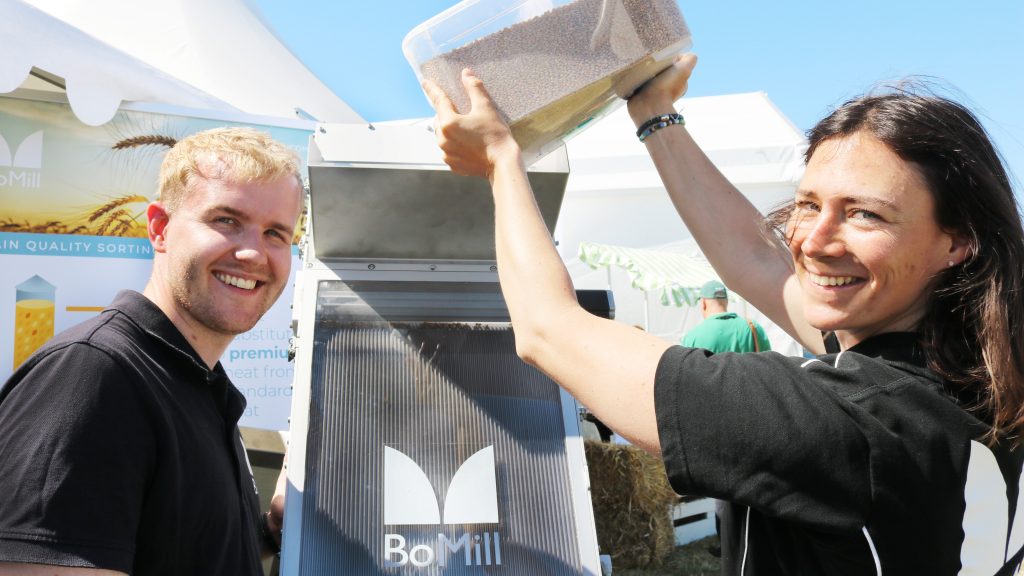
“Nobody else analyses the internal properties of every single kernel in this way. Typically, grain is assessed through sampling, with an average protein content measured for the batch. That average is not necessarily representative of the entire lot,” says Alexandra Persson, CFO at BoMill.
As demands on millers and maltsters continue to increase, particularly regarding the delivery of consistent and precisely specified grain quality, the ability to sort grain to achieve the desired specification is becoming increasingly important.
At the Borgeby agricultural fair, BoMill staff were present in the Agtech Sweden stand to demonstrate the company’s latest sorting technology, BoMill InSight™. BoMill has long been an industrial partner of Agtech Sweden and showcases its technology in collaboration with the Knowledge Hub for Digitalisation of Agriculture at Linköping University.
“We have followed BoMill’s development from an early stage,” says Per Frankelius, Director of Agtech Sweden. “We want our activities to cover a broad spectrum, rather than focusing solely on innovations in their early phases. BoMill is an excellent example of an innovation that has successfully established itself in both the milling and malting industries among important market players. The technology is also becoming increasingly recognised as a solution for sorting grain with variations in protein content.”
Near-infrared spectroscopy (NIR) has long been used in laboratory equipment, where small samples of a few kilograms are analysed to estimate the average composition of a much larger grain lot. In itself, that is not unique to BoMill. What sets the company apart is its use of NIR in transmission mode, combined with the ability to analyse more than 250,000 kernels per second in real time at capacities of up to 30 tonnes per hour.
With BoMill’s technology, every kernel passes through small channels at high speed. The kernel is illuminated with near-infrared light, its protein content is determined, and it is then sorted using compressed air. Other quality parameters can also be analysed and used as a basis for sorting.
“Our technology measures each individual kernel at up to 120 measurement points. NIR is already widely used throughout the grain industry, but conventional systems generally analyse either samples or grain in bulk. BoMill applies NIR at kernel level, making it possible to analyse and sort every kernel individually,” says Fabian Mathisson, Software Developer at BoMill.
The difference can have a direct impact on the value of the grain. All cultivated fields exhibit natural variation. Even within a single wheat ear, protein content is typically higher in kernels from the lower part of the ear and slightly lower in those from the top.
“If farmers can sort grain according to protein content directly on the farm, that is an advantage in itself. It also becomes possible to purchase a wheat lot at a lower price and then create new quality grades through sorting. That changes the starting point when the grain is sold on.”
About BoMill
BoMill is a Swedish company listed on Nasdaq Stockholm First North Growth Market and specialises in grain sorting and analysis. BoMill InSight™ can sort up to 30 tonnes of grain per hour. Thanks to its modular design, multiple sorting units can be connected and operated in parallel, making it possible to create a processing line tailored to individual operational requirements.
Kontakt