

24 august 2026
Aviation, advanced sensor systems, AI and large volumes of data may seem far removed from fields, livestock and agricultural machinery. But much of the technology and expertise developed around the aviation industry in Linköping is now finding new applications in agriculture.
The Linköping Air Show on 22–23 August attracted around 230,000 visitors. For Agtech Sweden, the event was also a reminder of another story: how the region’s long tradition of aviation, computer technology and advanced engineering has created expertise that is now contributing to the development of the farming of the future.

Flygdagarna-Ulrik-Svedin
Visitors were treated to spectacular aerial displays during the Linköping Air Show. Photo: Ulrik Svedin.
An innovation environment takes shape
Linköping’s strong position in aviation technology has developed over almost a century. As early as the 1930s, AB Svenska Järnvägsverkstädernas Aeroplanavdelning (ASJA) began manufacturing aircraft in the city. When Saab acquired ASJA in 1939 and moved its headquarters to Linköping, development accelerated further.
The demand for increasingly advanced aircraft drove the development of new expertise in areas such as electronics, computer technology, sensors, automation and advanced computing.
One important example is Datasaab, which developed advanced computer systems for, among other things, the Saab 37 Viggen fighter aircraft. Expertise in computing and data processing also contributed to the development of Linköping University. In 1975, the university launched Sweden’s first Master of Science in Engineering programme in Computer Science and Engineering.
The aviation industry’s need for advanced calculations and simulations later contributed to Saab and Linköping University establishing the National Supercomputer Centre (NSC) in 1989. Today, NSC is home to Berzelius, a supercomputer that is an important resource for Swedish AI research.
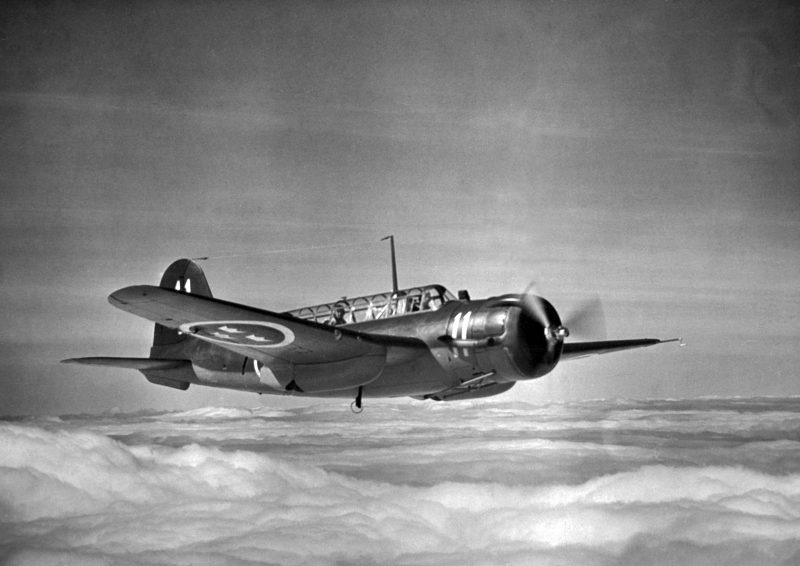
20100518-sv-262949-1
ASJA’s first aircraft. Photo: Wikimedia Commons.
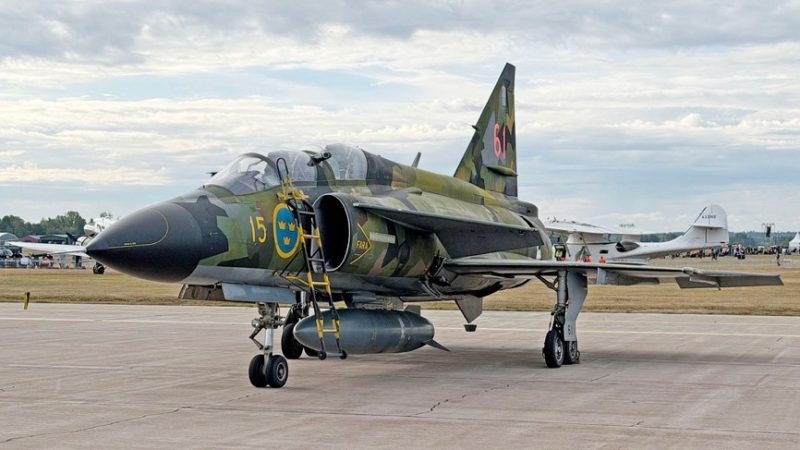
Viggen till beskådan under Flygdagarna i Linköping 22-23 augusti 2026
Viggen on display at the Linköping Air Show, 22–23 August 2026. Photo: Rickard Bergkvist, who also previously worked as a photo technician on the Viggen.
Technology finds new applications
Technology once developed to solve advanced problems in aviation now has applications in many other fields.
Sensors, camera technology, AI, automation and advanced data analysis are also central to the development of more precise and resource-efficient agriculture.
This can involve analysing large volumes of data from satellites, cameras and sensors, detecting changes in crops or animals, or controlling machinery with ever greater precision. What these applications have in common is the potential to make better decisions and use resources where and when they are really needed.
Östergötland has a particular strength in this respect: the close proximity between agriculture, universities, technology companies and a strong industrial tradition.
From Saab to the seed drill
One concrete example is the Flexrow project, where technology with links to the aviation industry has found an entirely new application.
The seed drill can vary the spacing between rows using HILA, a hydraulic solution developed by Magnus Landberg at Saab. Technology originating from advanced engineering has thus found a new purpose in the field.
Another example involves the use of cameras and AI to analyse animal respiration, where expertise from Saab, among others, has contributed to the development.
It is precisely these encounters between different fields of expertise that can lead to unexpected innovations. A solution does not have to have been originally developed for agriculture to solve a problem in farming.
Agtech Sweden builds on this legacy
Agtech Sweden was established in late 2018, but the initiative has its roots in earlier projects at Linköping University. Platforms such as Högteknologiskt lantbruk (High-tech Agriculture) and Grönovation brought together the university, the agricultural sector and companies including Saab, SSAB, 3M and IBM to explore new technological solutions for the green industries.
Today, Agtech Sweden continues to connect the needs of agriculture with expertise from different parts of industry and research.
Several ongoing projects draw on technology and expertise related to aviation, sensors, AI and advanced computer systems. Some are still at such an early stage of development that they cannot yet be described publicly.
From the air to the field
The potential is considerable. Technology developed to manage complex systems and vast amounts of data can help agriculture address a very different set of challenges.
Data from satellites, drones, soil moisture sensors, machinery and cameras can be combined and analysed to provide better decision support. AI can identify patterns that are difficult to detect in other ways. Automation and advanced control systems can enable more precise use of inputs, reducing both costs and environmental impact.
The aviation industry and agriculture have different purposes. But they share a need for precision, robust systems, advanced technology and the ability to make the right decisions based on large amounts of information.
For Agtech Sweden, it is therefore natural to look for innovations beyond the traditional boundaries of agriculture. The next solution for the farming of the future may well be based on technology originally developed for something entirely different.
Contact