
'/%3E%3C/svg%3E)
14 July 2026
A small, smart hitch pin can provide farmers in the tractor with better information about how much pulling force is required to tow a trailer or implement.
Agtech Sweden presented the technology at Borgeby Field Days and Brunnby Agricultural Days 2026, where testing the pulling force by hand proved popular with visitors. The pin has been developed by Flintec based on input from Scandinavian Farmers, Växtab, Tolefors and Linköping University. It contains a strain gauge that measures pulling force.
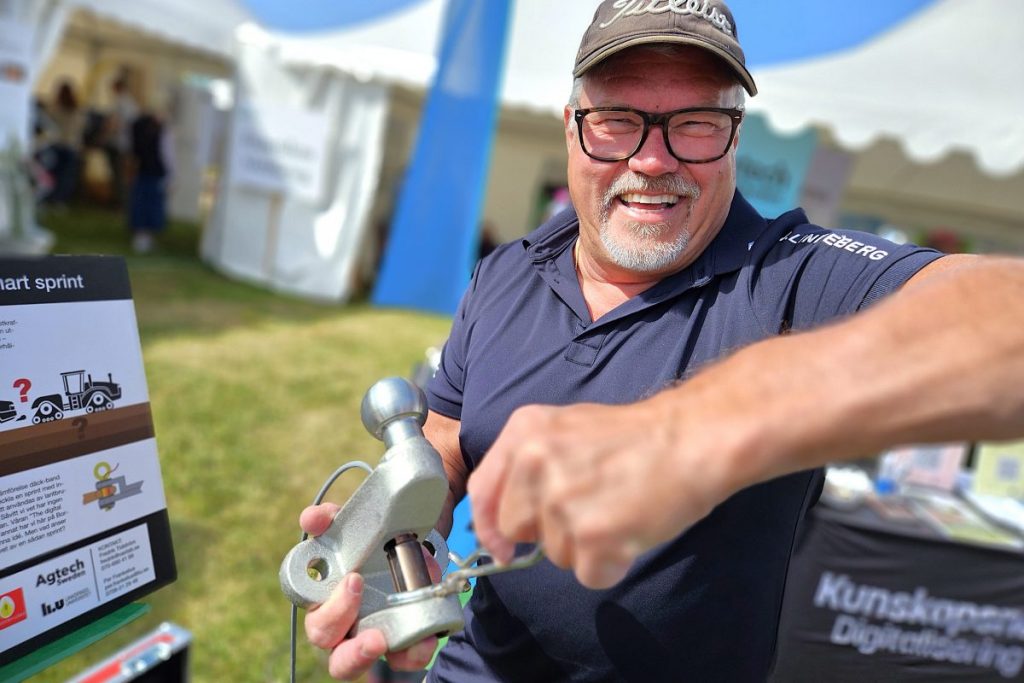
Smarta-sprinten-1-Anders-Larsson-Flintec-1200×800
Anders Larsson, technical consultant at Flintec, demonstrates the smart hitch pin that measures pulling force.
Increasingly important
“We believe in the idea of measuring pulling force at the tractor hitch. Implements do not provide much information about the soil. As more and more technology becomes digitalised, and as we potentially move towards autonomous tractors, this type of information will become even more important,” says Per Frankelius, Agtech Sweden.
Anders Larsson, technical consultant and former CEO of Flintec, also sees considerable potential in the smart hitch pin:
“Agtech Sweden’s approach of bringing together different areas of expertise in this project is very interesting. Measuring force and weight is our specialist field, and we have world-leading technology in this area. Knowing more about how much force is being transferred into the soil is highly relevant to farmers. Optimisation, measurement and precision are becoming increasingly important in agriculture, and this product could be part of that development,” says Anders Larsson.
Saving fuel
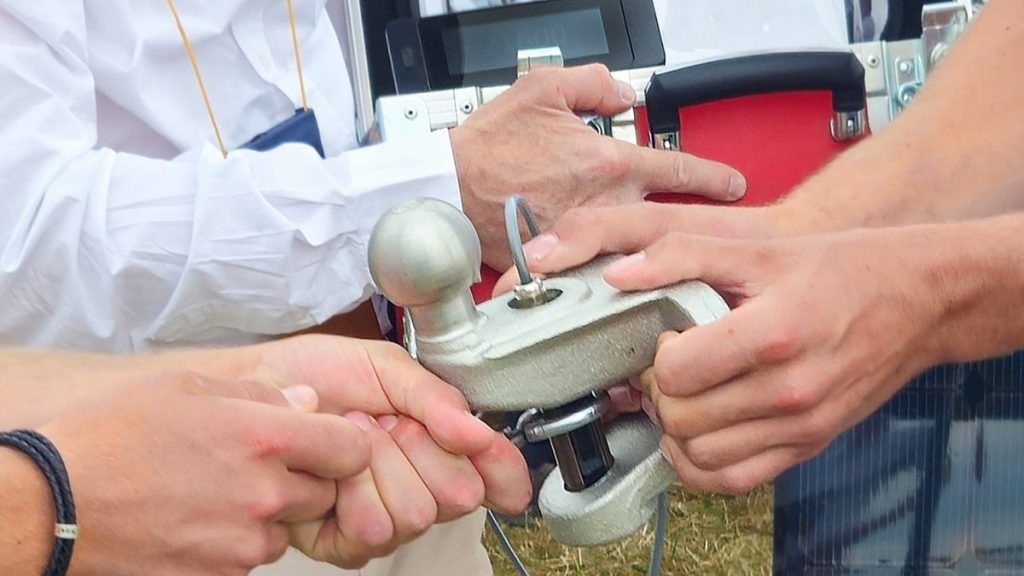
Brunnby-Flintec-Drag3-1200×675
Curious visitors were keen to try pulling on the pin being developed by Flintec. The pin measures pulling force, information that can be useful when towing agricultural implements, for example to minimise soil compaction. Farmers may want to know, for instance, whether a plough is operating too shallowly or too deeply.
A 120-horsepower tractor typically generates a pulling force of 3–5 tonnes during normal fieldwork. How much of the engine power is converted into pulling force depends, among other things, on speed and tyre traction.
Measuring pulling force can provide information that helps save fuel, for example by providing better knowledge of implement depth and other resistance in the soil. Tyre or track traction and wheel slip are also important factors to monitor during fieldwork. When wheels slip, clay soils can be subjected to smearing and deformation as the soil is worked excessively. This can damage soil structure and affect plant root development.
A well-known problem
Soil compaction is a well-known problem in agriculture. Measuring pulling force can also help optimise the amount of power that is actually required.
“When you have information about what is actually needed, you may not need to take the largest tractors out into the fields,” says Per Frankelius.
The hitch pin project is part of the larger project System comparison of tyres and tracks using a smart hitch pin.
A missing piece
“As far as we know, no one has previously introduced this type of hitch pin to the market. What we are doing now is presenting the idea that such a pin should exist,” says Per Frankelius.
The project involves Flintec, Scandinavian Farmers, Växtab, A-Electronic, Tolefors Gård, a-Electronix, Agtech Sweden, the Swedish University of Agricultural Sciences (SLU) and Linköping University.
Contact