

21 October 2025
Sweden has one of the most sustainable agricultural sectors in Europe, with low antibiotic use and low environmental impact. At the same time, increased food preparedness and reduced dependence on imports are needed.
This analysis is made by Magnus Kagevik, CEO of Lantmännen, Sweden’s largest food producer with 17,000 members. He gave a lecture on food preparedness at Future Day, organised in Linköping by Agtech Sweden in collaboration with the Swedish Farmers’ Association (LRF) and Vreta Kluster. The theme was preparedness, with much of the focus on energy issues, climate adaptation and food production.
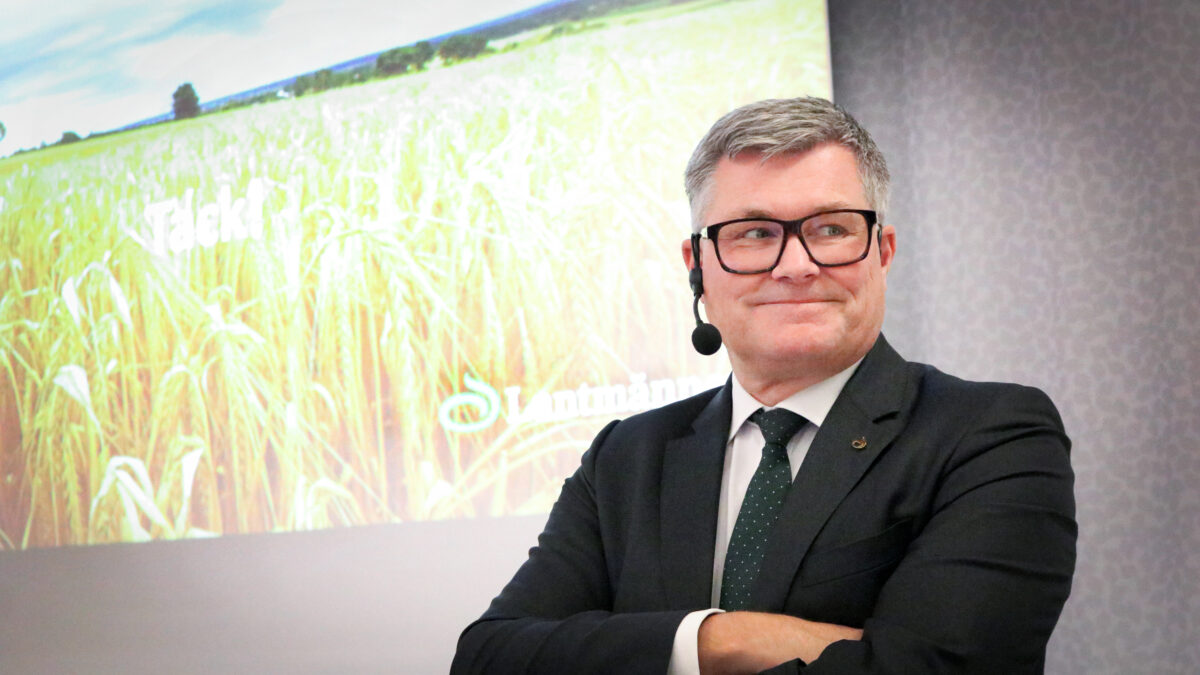
Magnus Kagevik outlined both strengths and risks in Swedish food production and pointed to the need for new strategies.
“We are best in class when it comes to antibiotic use in animal husbandry. Yet as consumers we pay a premium for products such as air-dried ham from Spain and Italy,” said Kagevik.
He emphasised that many consumers are not aware of how sustainable Swedish agriculture actually is.
“We are very good in Sweden at producing food. But historically, this is not something we have talked about. We also have a strongly growing food culture, with many skilled chefs and engaged consumers.”
He then pointed out that Sweden has a trade deficit of SEK 80 billion in agricultural and food products, making the country one of the most import-dependent in the EU.
“We import half of all the food we eat. At the same time, we have favourable conditions to produce food, both for ourselves and for others. We can become a food-exporting country. But we have not talked much about this factor. When we talk about exports, it is usually about technology such as compressors, trucks and telecommunications.”
He compared Sweden with Ireland, which through a national strategy has built up a surplus in beef production corresponding to 760 per cent self-sufficiency. Sweden stands at 52 per cent.
“Ireland’s success is no coincidence. It is based on collaboration between the government, authorities and farmers. We have much to do, but also unique opportunities.”
According to Magnus Kagevik, Sweden can compete in export markets in both primary production (raw materials such as crop cultivation, livestock farming and hunting/fishing) and food production.
“Right now, there is a window of opportunity for Swedish production. This is because we are best in class in several areas, for example in animal husbandry and in our significantly lower use of plant protection products compared to many other EU countries. It is also due to the climate, where Sweden will not be affected to the same extent by heatwaves and other extreme weather events as countries in southern Europe.”
The most serious point in his presentation concerned Sweden’s shortcomings in food preparedness. The Swedish Board of Agriculture and several other authorities are now working to build preparedness through larger central storage facilities.
“At present, food preparedness is low. We need to build up larger stocks. But there are no stockpiles in the world that can supply a population throughout an entire war. We must build systems that keep production running.”
In conclusion, he mentioned the government’s new food strategy:
“What is positive about Food Strategy 2.0 is that it is a growth strategy. We now have the opportunity to accelerate and increase significantly. Sweden has all the prerequisites to build a strong, sustainable and resilient food industry. But this requires political will, collaboration and a long-term strategy.”
Contact