

21 october 2025
The forestry industry plays a decisive role in Sweden’s climate transition. This was emphasised by Holmen’s CEO Henrik Sjölund when he visited Future Day 2025. He was one of the speakers at Future Day, organised by Agtech Sweden in collaboration with the Swedish Farmers’ Association (LRF) and Vreta Kluster. The seminars were held at Vreta Kluster in Linköping. The theme was preparedness, with much of the focus on energy issues, climate adaptation and food production.
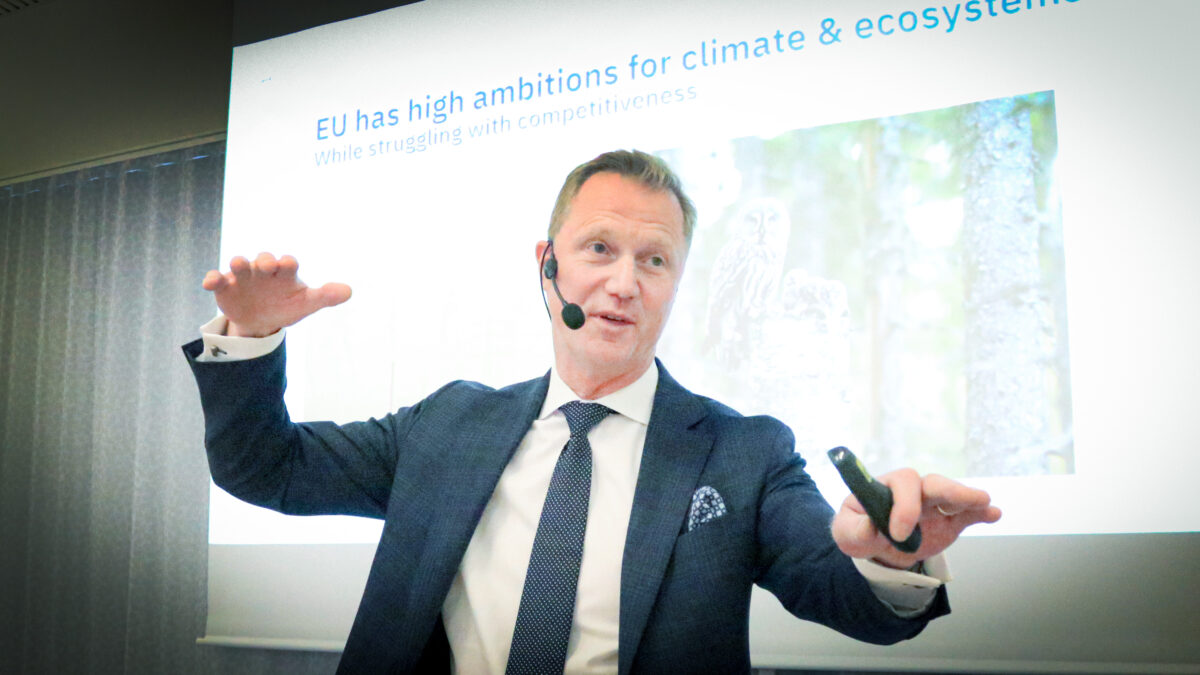
Holmen, with its origins in Norrköping (head office in Stockholm), is both a forest owner, an industrial company and an energy producer. The company operates on a global market within the sawmill, paper and paperboard industries. Holmen is publicly listed and owns 1.3 million hectares of land, of which one million hectares are used for active forestry.
“Long-term thinking is a given. We grow trees with a horizon of 80 to 100 years. We plant approximately 2,000 seedlings per hectare and harvest 700 trees on the same area 60–80 years later. What we extract between planting and final felling becomes pulp, paper, paperboard and bioenergy,” explained Henrik Sjölund.
Henrik directed sharp criticism at the view of the forest as a passive carbon sink rather than an active climate resource that both binds carbon and replaces fossil alternatives.
“I usually say that we grow houses. We can conduct modern and active forestry where, through high growth in the forest, we both bind carbon dioxide in the growing trees and in wooden constructions. Forest products replace fossil-based alternatives such as steel and concrete. Wood provides greater climate benefits when it replaces fossil alternatives than by simply letting the forest stand and grow,” said Henrik Sjölund.
He emphasised that as a major forest owner, it is natural to own sawmills and refine timber, the most valuable resource in the forest. Hydropower also has a direct link to land ownership. The company owns just over 20 hydropower plants, mainly in northern Sweden, and has also invested in wind power.
“A large share of hydropower is produced in the rivers of northern Sweden, but we also have a couple of plants in the Motala River. At the same time as we produce electricity, our industries are also among Sweden’s largest electricity consumers.”
Energy issues were given significant attention in the presentation, particularly the imbalance between northern and southern Sweden. While a large share of Sweden’s fossil-free electricity is produced in the northern parts of the country, electricity shortages and high prices occur in southern Sweden.
“There is currently a surplus of 50–60 terawatt-hours in the north. But we cannot transfer enough electrons from north to south. Why should you pay this much for electricity when it was free in northern Sweden last week?”
Henrik described how large amounts of wind power in northern Sweden are not utilised because prices are so low that the calculations do not add up.
“It is a major waste for Sweden as a country not to be able to make use of the production of green electricity in northern Sweden. We must urgently remove the bottlenecks in the grid so that electrons can flow freely and provide value where they are needed.”
He proposed a solution:
“Lay a subsea cable from Umeå to Forsmark and expand the regional and local grids. Based on other cables that have been built, I estimate that such a cable would likely cost around SEK 30 billion. That money is already more than available in the congestion revenue account,” concluded Henrik Sjölund.
Contact